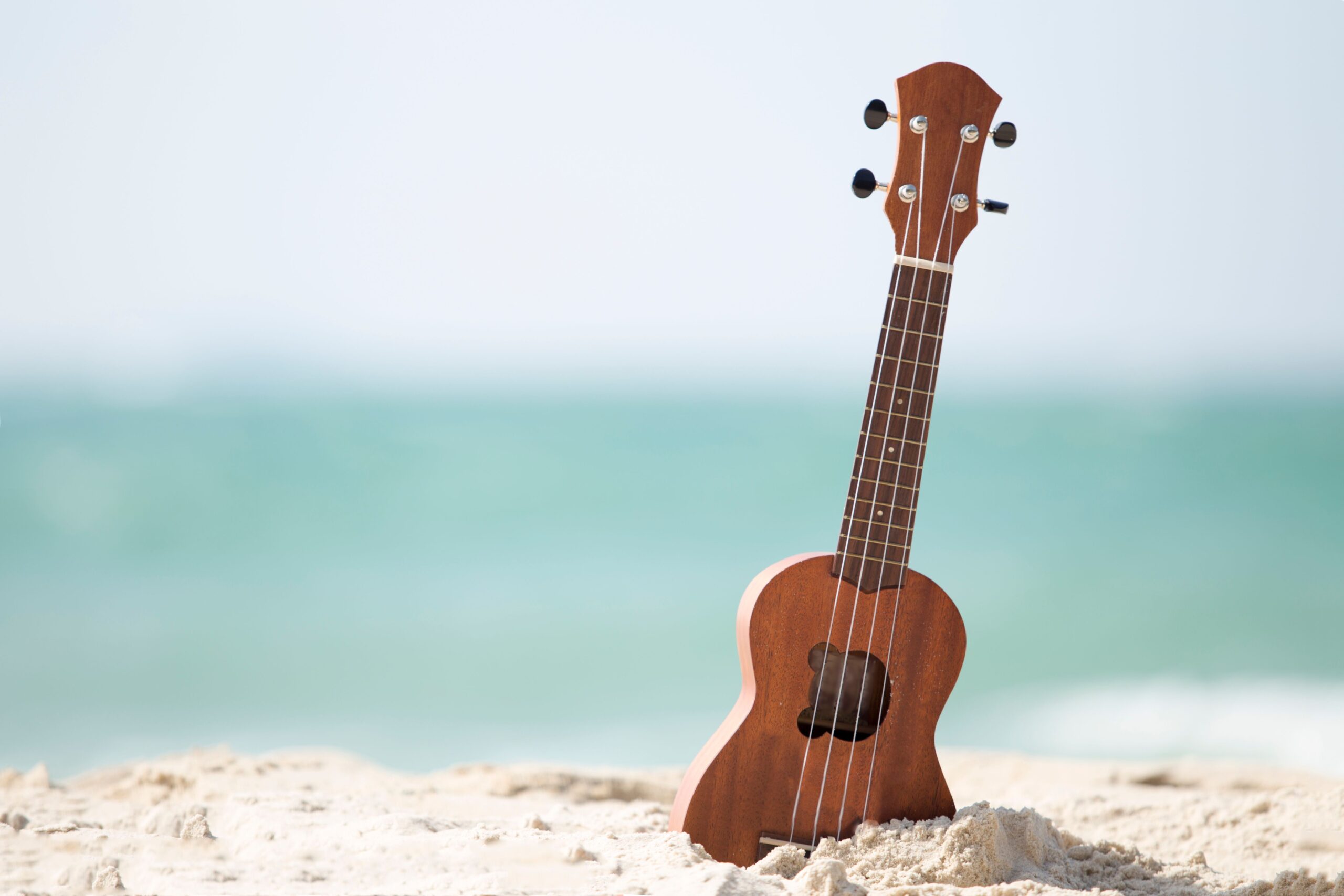
Hawaii is often cited as the origin of the ukulele, but it actually traces back earlier to Portuguese cabinet makers who came from Madeira to Hawaii in 1879. They introduced the islands to a metal 4-string instrument called the machete. A simpler version of the machete with slightly different tuning was renamed the ukulele throughout Hawaii in the 1880s and began to resemble what it is today.
Early Hawaiian Ukes
During the 1880s musical instrument shops began to open in Hawaii as the ukulele, made of local koa wood, went on sale and became a hit. Hawaii’s final queen, Lili’uokalani, said ukulele means “the gift (uku) that came here (lele).” As Hawaii lost its sovereignty as an independent nation and became a U.S. territory the following decade, the ukulele became a political symbol associated with social struggle and independence. Others have translated the instrument’s name to mean “jumping flea.”
Hawaii’s new government used the instrument as a marketing concept to attract tourism to the islands. They used images of women in long grass skirts playing the uke on a beautiful tropical shore. By 1915 the popularity of the instrument spread to the mainland United States and beyond.
Ukes in Popular Culture
Over the past century, the uke has been featured in countless hit recordings and a resurgence has been building this century. The appeal of the instrument is that it’s easy to play, easy to transport and it sounds wonderfully happy with its high pitched strings, which contribute to its bright upbeat quality.
The Wizard of Oz movie soundtrack classic “Somewhere Over the Rainbow” was covered by Israel Ka’ano’i Kamakawiwo’ole in 1993. It was widely adored around the world, contributing to the uke’s popularity. Other hit recordings to prominently showcase the instrument have been “Hey, Soul Sister” by Train, “Fearless” by Taylor Swift, “I Do” by Colbie Caillat and “I’m Yours” by Jason Mraz.
Paul McCartney and George Harrison both played ukes in their 1994 Beatles Anthology project. Pearl Jam singer Eddie Vedder recorded a solo album of uke songs in 2011. In recent decades the Elvis ballad “Can’t Help Falling in Love” and the Beatles’ classic “Here Comes the Sun” has been widely covered featuring the uke.
Musician Benefits
Since it only has four strings instead of six, a uke is easier to tune, learn, play and maintain than a guitar. The uke has become a popular portable instrument because it’s small, lightweight has visual appeal and can be taken anywhere.
It’s also much easier to record than an acoustic guitar, which has more bottom end that requires more careful microphone placement to avoid distortion. The nicest uke sounds can be captured if the mic is not directly pointed at the instrument.
The best thing about the uke is that the sound alone is widely loved around the world. The uke is an easy crowd-pleaser as long as you can play the music well. As a healing device, it can lower stress and brighten anyone’s day.